 with d
ij = d
ij = d
ij = d
ij
Rigid body dynamics
Michael Flynn
3rd Physics
A rigid body is one in which the relative position of the parts of the body remains unchanged during motion. This means that the body will move as a whole.
This is obviously a highly idealised definition. If the size and shape of a body vary only slightly under the action of external forces, then the body may be regarded as a rigid body.
Of course one consequence of the special theory of relativity is that a rigid body cannot exist. This is because it is not possible for an entire body to move instantaneously as a single unit when an external force is applied at any point.
The first part of this experiment contains a derivation of Euler's equations of motion. This is then followed by the application of the equations to a symmetrical spinning top and a ?..
Notation
The notation used in this report will follow the Einstein summation convention. This means that a superscript i on v means the ith component of the column vector v. A subscript i on v means the ith component of the row vector v.
The Kronecker delta function is defined by with d
ij = d
ij = d
ij = d
ij
Therefore vi = d ij vj and vi = d ij vj
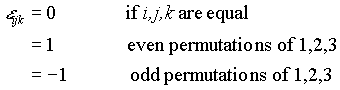
We must also define the Levi-Civita tensor
Therefore,
e 123 = e 312 = e 231 = 1
e 231 = e 132 = e 213 = -1
and all other combinations are zero.
v x w = Eijk vj wk ei Here ei is the ith vector in an ortho-normal Cartesian basis.
Lemma 1

Proof:
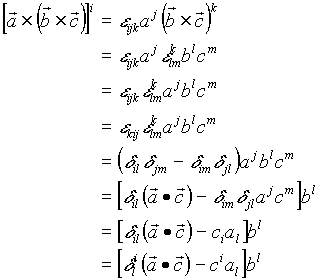
In the special case of  , then

Rate of change of angular momentum equals external torque
Proof:
i
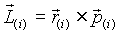 for point i
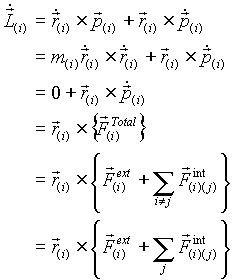

Taking the internal torque as equal to zero, as otherwise bodies subjected to no external torques could spontaneously begin to spin, we obtain

Moving Frames
Consider the following diagram. K and K? are two frames of reference and O and O? are the respective origins.
K?
K O?


 P
For any point P we have the following relationships.

If we define  and let
 then we obtain

Expanding this, while taking  and defining
 we arrive at

If we now consider acceleration
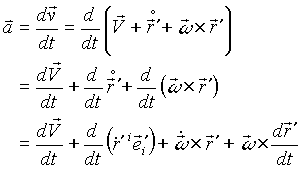
Defining  and expanding this expression we arrive at

Euler?s Equations for Rigid Bodies
O?


If we define  as the total angular momentum of a body. Then
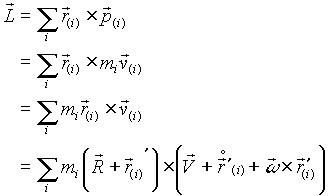
 because of rigidity.

To simplify the calculations we choose the origin of the K? frame in such a way that

This can be done by choosing O? to coincide with the centre of mass of the body, .
Hence,

Using lemma 1, this gives

We can now define the moment of inertia tensor as
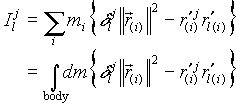
Therefore,

This relationship holds if O? = centre of mass and hence 
We can now calculate the torque, , by differentiating
 and expanding
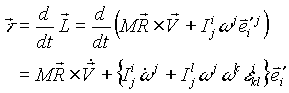
In the presence of no internal moments,
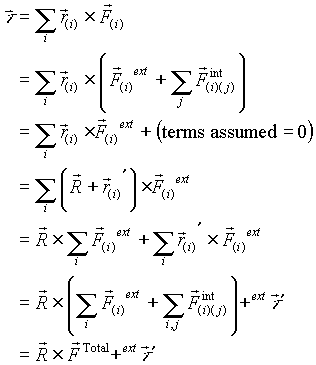
where is the external torque in K?. Also one should bear in mind that
 is being taken as equal to zero.
If we equate the two expressions for
 *
However,
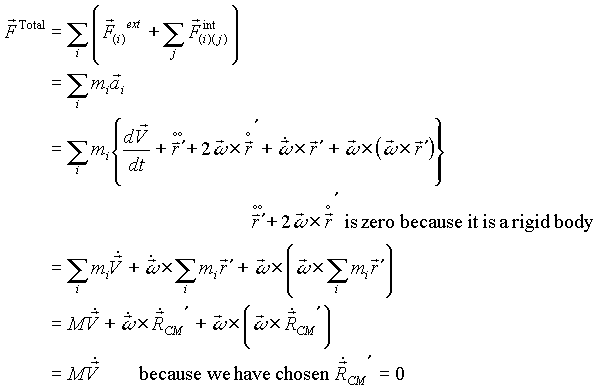
Therefore we can equate (*) term by term. In conclusion when there are no internal torques

where = external torque with respect to centre of mass =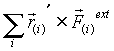
and the origin of the moving frame is at the centre of mass.
Now we can just consider

If we assume that a basis has been calculated so that the inertia tensor is a diagonal matrix, i.e. 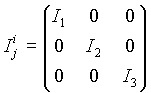 , then
 if
 .
Therefore,
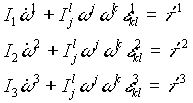
If we just consider the first equation, we realise that there are 27 terms in the expansion of  . However, 25 of these are equal to zero, which just leaves us with

Cyclic permutations on the set {1,2,3} gives the other two equations :

We can now write Euler?s equations in their normal form:

Motion of a torque free symmetrical top
We will now consider the motion of a heavy symmetrical top spinning freely about its axis of symmetry under the influence of a torque produced by its own weight.
As we are dealing with a symmetrical rigid body top, two of the three principle moments of inertia are equal. We will take the z-axis as the axis of symmetry and let  be the moment of inertia about this axis. We will take
 as the moment of inertia about the x ? and y- axis. Euler?s equations can then be reduced to this form:

The last equation can then be reduced to

This means that  is constant in time.
If we define the constant k as

then the first two equations take the form of

If we differentiate the first and substitute into the second we obtain

Obviously  is positive and we just have the equation of harmonic motion. Therefore,

where A (constant) is the amplitude of  and
 is a phase constant.
We can now also obtain a solution for 
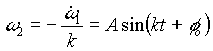
The equations of motion are therefore
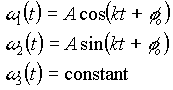
The first two equations are the parametric equations for a circle of radius A in the plane of the xy axes. The projection of the  vector onto the xy plane rotates about the z-axis with a constant angular frequency k. Obviously,

is constant during the motion.
The diagram below illustrates the geometrical relationship of  toat a particular instant. If the phase constantis chosen to be zero, then at
 ,
 and
 . As t increases,
 decreases while increases. This shows that the axis of rotation precesses and describes a right circular cone about the z-axis (axis of symmetry) counterclockwise with an angular velocity k.
The period of the precession is given by
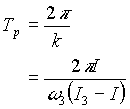
The rotation of the earth can be considered as a rigid body of this type. The angular velocity of the earth is 7.29´
10-5 rad/sec. The quantity  was determined astronomically to be 0.00329. Substituting in these values we find that
 days.
 has been measured experimentally as 432 days, we account for the significant difference by the fact that the earth is not a rigid body (i.e. tides ,etc. )